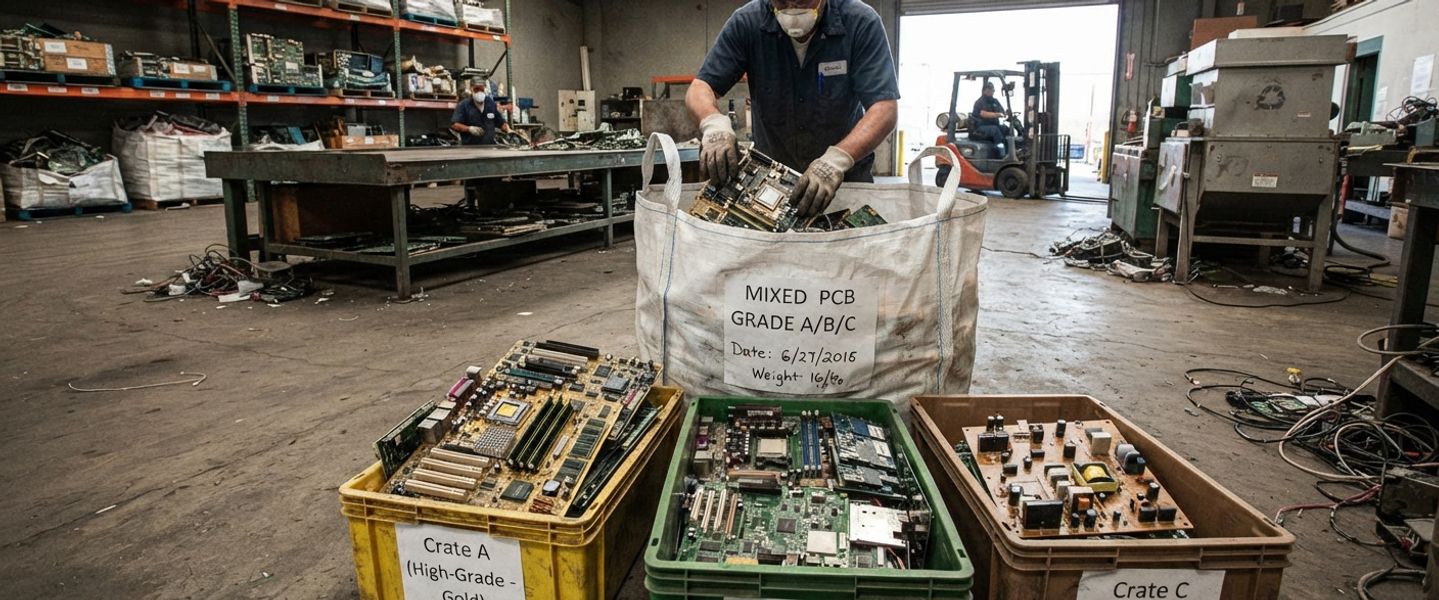
Within the global electronic waste (e-waste) recycling ecosystem, Printed Circuit Boards (PCBs) represent one of the most lucrative commodities due to their concentration of precious and base metals—primarily gold (Au), palladium (Pd), silver (Ag), and copper (Cu). However, because metal recovery yields vary drastically across different types of electronics, the industry classifies boards into three primary tiers: Grade A (high-grade boards such as server motherboards, RAM sticks, graphics cards, and telecom modules), Grade B (medium-grade boards like standard desktop motherboards, laptops, and set-top boxes), and Grade C (low-grade boards including power supply units, TV boards, and household appliances).
For scrap aggregators and traders, blending these three grades into a single commercial shipment is a common practice used to move slow-selling Grade C inventory while maintaining healthy cash flow. However, bulk buyers, exporters, and precious metal refineries employ seasoned Quality Control (QC) inspectors who can accurately estimate the recovery yield of a 1-ton jumbo bag within minutes of visual inspection and core sampling.
If you intend to blend Grade A, B, and C circuit boards into a single lot, ensure your warehouse team avoids these four costly mistakes:
1. Mixing Without Depopulating Heavy Contaminants
One of the most frequent errors made by newcomers is tossing Grade C boards—such as computer power supply units (PSUs), CRT/LED television boards, or audio amplifier boards—directly into a batch with Grade A boards without proper depopulation (removing bulky non-precious attachments).
Components such as large electrolytic capacitors, copper/iron transformers, ferrite coils, steel mounting brackets, and aluminum heatsinks contain zero precious metals. To a smelter or hydrometallurgical refinery, these items represent dead weight and slag-forming contaminants that inflate shipment tonnage without contributing to gold or palladium recovery. When QC inspectors spot heavy attachments mixed into the batch, they do not merely deduct weight from the Grade C portion; they apply a lot-wide penalty deduction across the entire gross weight, effectively slashing the payout on your high-value Grade A boards as well.
2. Leaving Stripped or "Bare" Boards in the Mix
In local scrap yards, it is common to encounter circuit boards whose high-value components—such as BGA IC chips, tantalum capacitors, and gold-plated edge connectors—have already been harvested (stripped) for separate resale or small-scale recovery. Some traders attempt to slip these leftover bare fiberglass boards into Grade B and C blends simply to add weight.
This short-sighted tactic causes severe financial damage. Stripped boards no longer meet the baseline precious metal threshold required for commercial mixed loads. When the buyer conducts a laboratory fire assay or XRF (X-Ray Fluorescence) analysis on sampled material, the presence of bare boards drastically dilutes the average parts-per-million (ppm) yield of gold and palladium per metric ton. The result is an immediate price downgrade on the current shipment and permanent loss of buyer trust for future transactions.
3. Letting Grade C Exceed 50% of the Total Volume
The fundamental purpose of commercial PCB blending is to leverage the high gold/palladium content of Grade A and the rich copper base of Grade B to elevate the overall marketability of Grade C boards. Unfortunately, many sellers get overly ambitious by loading 60% to 70% Grade C material and sprinkling in a small fraction of Grade A boards to dress up the lot.
An unwritten rule in commercial scrap PCB trading is maintaining a visual and component density profile dominated by high-IC-density boards (Grades A and B). If more than half of the jumbo bag visibly consists of brown phenolic paper boards (commonly found in low-cost consumer appliances) or sparse single-sided green boards, buyers will immediately classify the entire shipment under a Low-Grade Mix pricing tier. At that tier, pricing is calculated almost exclusively on copper and resin recovery, meaning the precious metal value of your Grade A boards is essentially forfeited.
4. Ignoring Multi-Layer Distribution and Engaging in "Topping"
Modern circuit boards in Grade A and upper Grade B categories (such as smartphone logic boards, enterprise networking gear, and server blades) are engineered with multi-layer architectures—meaning conductive layers of copper and precious metals are embedded internally within the fiberglass substrate. Conversely, Grade C boards are predominantly simple single-layer or double-layer designs.
A critical operational mistake occurs when warehouse staff dump all Grade C boards at the bottom of a jumbo bag, layer Grade B in the middle, and place all Grade A boards strictly on top—an industry-frowned-upon practice known as "topping." Experienced buyers never draw assay samples solely from the top surface. They routinely dump entire bags onto sorting tables or use deep core-sampling augers to extract material from the middle and bottom layers. When bottom-layer samples reveal low metal concentrations inconsistent with the top layer, the buyer will immediately issue a unilateral grade downgrade across the entire container.
Practical Warehouse SOP: How to Blend Scrap PCBs Profitably
To ensure your mixed PCB shipments pass strict QC inspections, achieve consistent laboratory assay results, and secure top-tier market payouts, implement the following Standard Operating Procedure (SOP):
- Sort and Depopulate First: Ensure all boards across Grades A, B, and C are thoroughly stripped of aluminum heatsinks, steel brackets, lithium CMOS batteries, and oversized capacitors prior to weighing.
- Follow Proven Blending Ratios: For a standard commercial blend that safely avoids low-grade classification, stick to a ratio of 15% Grade A + 50% Grade B + 35% Grade C. If you are fulfilling an export contract or targeting a higher refinery tier, adjust your blend to 30% Grade A + 60% Grade B + 10% Grade C.
- Use Proportional Layering: Never dump entire grades in separate blocks. Load your jumbo bags in proportional increments—for example, every time your team loads 35 kg of Grade C, immediately blend and layer it with 50 kg of Grade B and 15 kg of Grade A. Repeat this cycle until the bag is full so that samples drawn from any depth yield uniform assay metrics.
- Document Pre-Mix Weights: Photograph or record short video clips of each grade on the scale before blending them together. Transparent documentation provides strong leverage during price negotiations and protects you against unfounded quality disputes.
By enforcing disciplined sorting and proportional blending standards, you protect your bottom line from costly QC deductions while building a reputation as a reliable, high-integrity supplier to refineries and international buyers.